

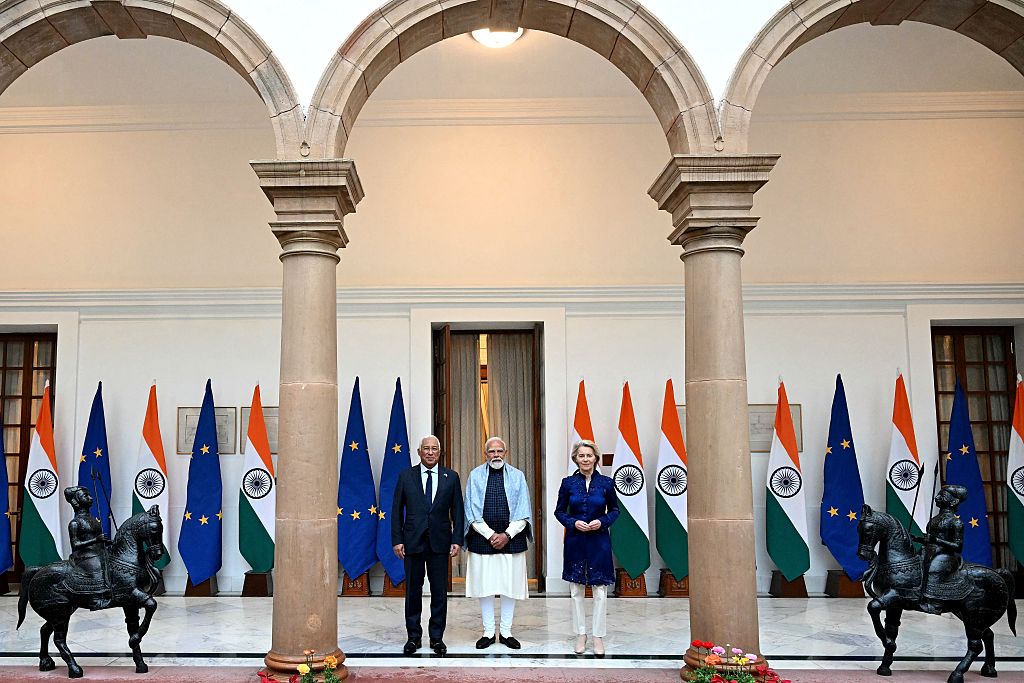
Why is the India–EU relationship important right now?
India and the European Union are on the verge of signing one of their most comprehensive trade agreements ever, expected around January 26.
After nearly two decades of on-and-off negotiations, talks restarted in 2022 and are now approaching closure.
This moment is critical because it comes amid:
- Global supply chain disruptions
- Strategic competition with China
- Climate transition pressures
- A shifting multipolar world order
🌍 SIGNIFICANCE OF INDIA–EU RELATIONS
1️⃣ Major Economic Partnership
- EU is India’s 2nd largest trading partner (after the US)
- Annual goods trade: ~$137 billion (2024–25)
- EU is India’s largest export destination
- India is the EU’s 10th largest trading partner
2️⃣ Foreign Direct Investment (FDI)
- EU accounts for 17% of total FDI inflows into India
- EU-to-India FDI grew 70% (2015–2022)
- France’s investment alone rose by over 370%
3️⃣ Shared Democratic Values
Both sides support:
- Democracy & rule of law
- Multilateralism
- Rules-based global order
This makes the partnership strategically deeper than mere trade.
4️⃣ Counterbalance in a Multipolar World
India and the EU act as independent poles, resisting:
- A unipolar world
- A rigid US–China bipolar order
5️⃣ Supply Chain Diversification (“China +1”)
- Pandemic & Ukraine war exposed overdependence on China
- India offers manufacturing scale
- EU brings capital, technology, and standards
6️⃣ Climate & Clean Energy Leadership
Joint focus on:
- Green hydrogen
- Solar power
- Energy efficiency
- Sustainable industrial transition
7️⃣ China Factor
Both see China’s economic and strategic assertiveness as a long-term challenge, though threat perceptions differ.
⚠️ CHALLENGES IN INDIA–EU RELATIONS
1️⃣ Stalled Free Trade Agreement (FTA) Issues
Key sticking points:
- EU wants tariff cuts on autos, wine, dairy
- India wants mobility for professionals (Mode-4)
- Disputes over Geographical Indications (GIs)
- Data localization & digital trade concerns
- Labour and environmental standards as non-tariff barriers
2️⃣ Carbon Border Adjustment Mechanism (CBAM)
- EU’s carbon tax on steel, cement, aluminium
- Seen by India as discriminatory green protectionism
3️⃣ Visa & Mobility Restrictions
- Tight EU visa regimes for Indian students and professionals
- Weakens people-to-people and innovation links
4️⃣ Defence & Strategic Gaps
- India’s reliance on Russian defence platforms
- Limits deeper EU–India military integration
5️⃣ Ukraine–Russia Conflict
- EU views Russia as a primary threat
- India maintains strategic neutrality
- Creates trust and perception gaps
6️⃣ China: Different Threat Perceptions
- China is India’s direct military rival
- For the EU, China is primarily an economic-security challenge
- Russia remains EU’s immediate security focus
🔄 INITIATIVES STRENGTHENING THE PARTNERSHIP
- Restart of FTA, Investment Protection & GI talks (2021)
- India–EU Trade and Technology Council (TTC)
- Strategic Partnership Roadmap (2025)
- Maritime cooperation in the Indo-Pacific
- Clean Energy & Climate Partnership (CECP)
- R&D collaboration (nuclear energy, CERN)
- Connectivity initiatives as alternatives to BRI
- IMEC corridor linking India, Middle East & Europe
🧭 WAY FORWARD
- Fast-track FTA with phased flexibility
- Joint solutions on CBAM & green finance
- Deepen cooperation in AI, semiconductors & cyber security
- Expand defence co-production & maritime security
- Create structured mobility frameworks for students & professionals
- Strengthen multilateral coordination (UN, WTO, G20)
🔚 CONCLUSION
India–EU relations are no longer optional—they are strategically necessary.
If aligned smartly, this partnership can shape global trade rules, climate solutions, and technological governance in the 21st century.